
The Tower Bindings
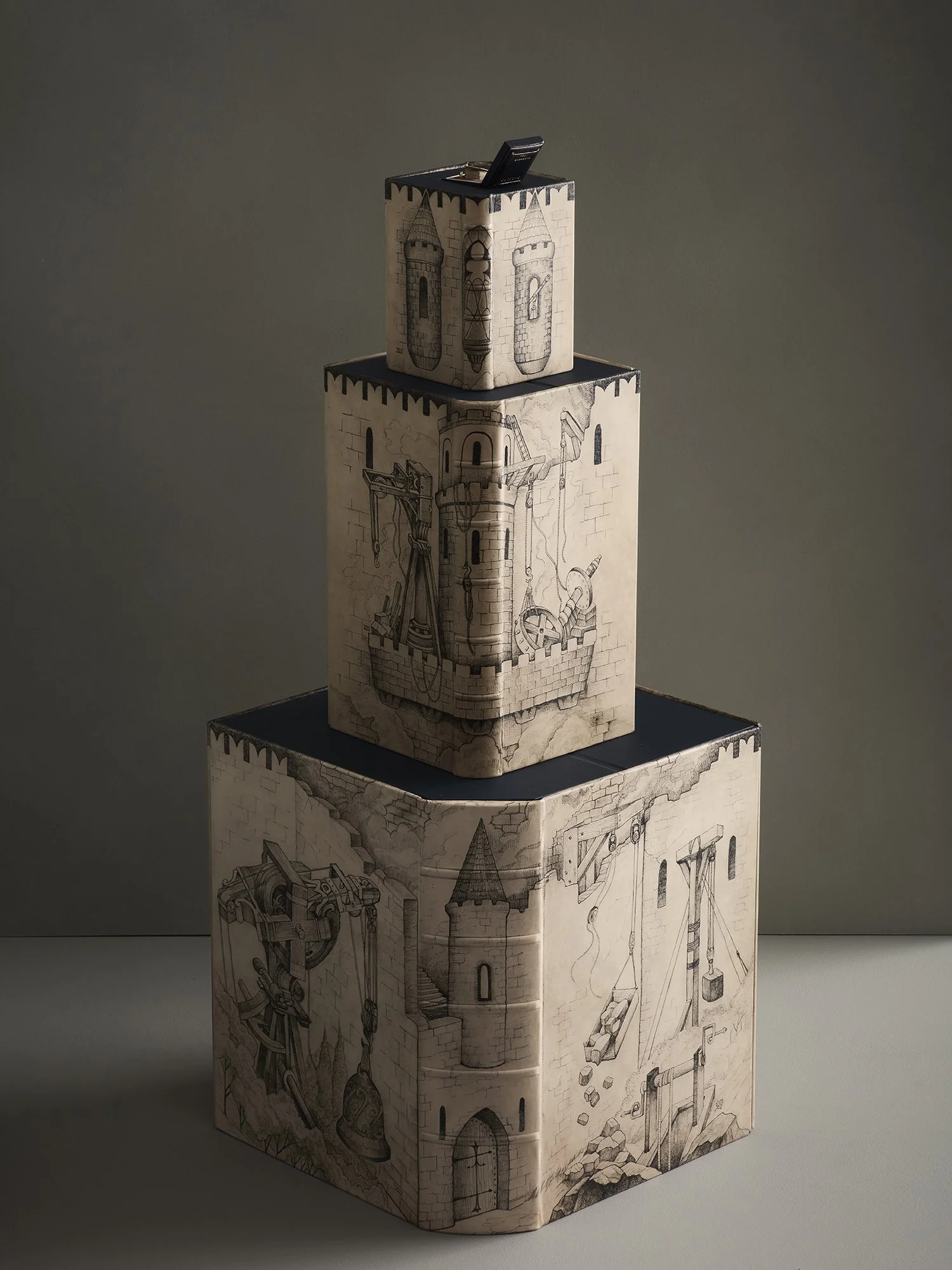
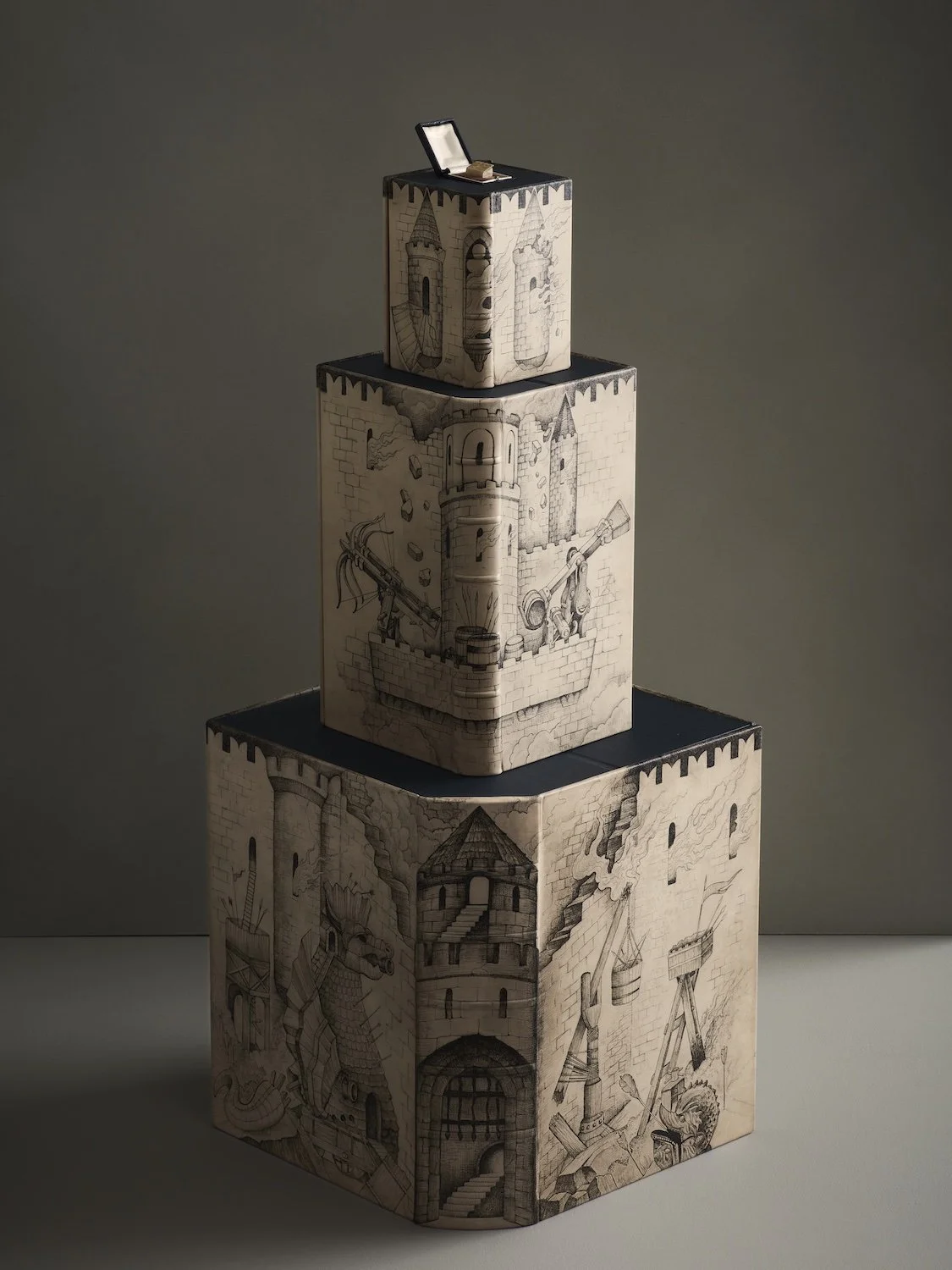
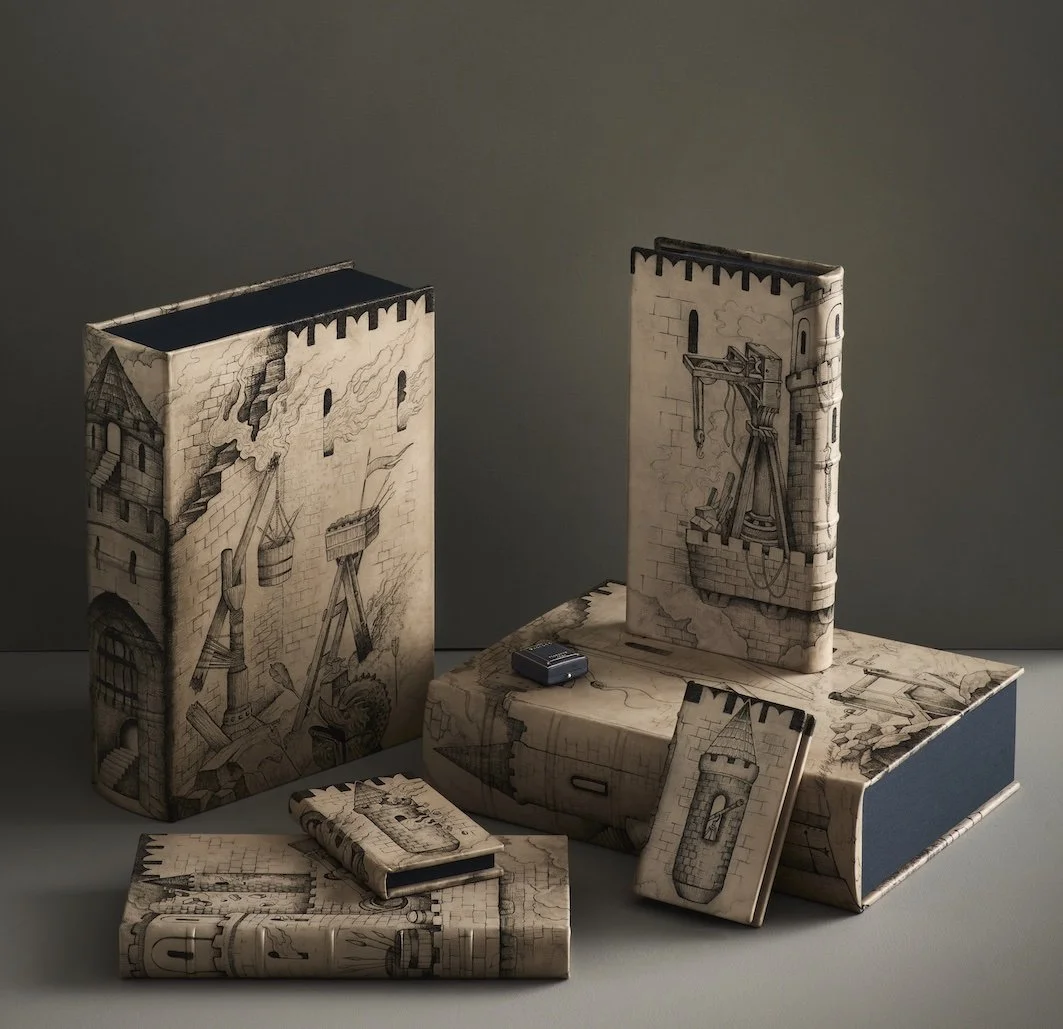
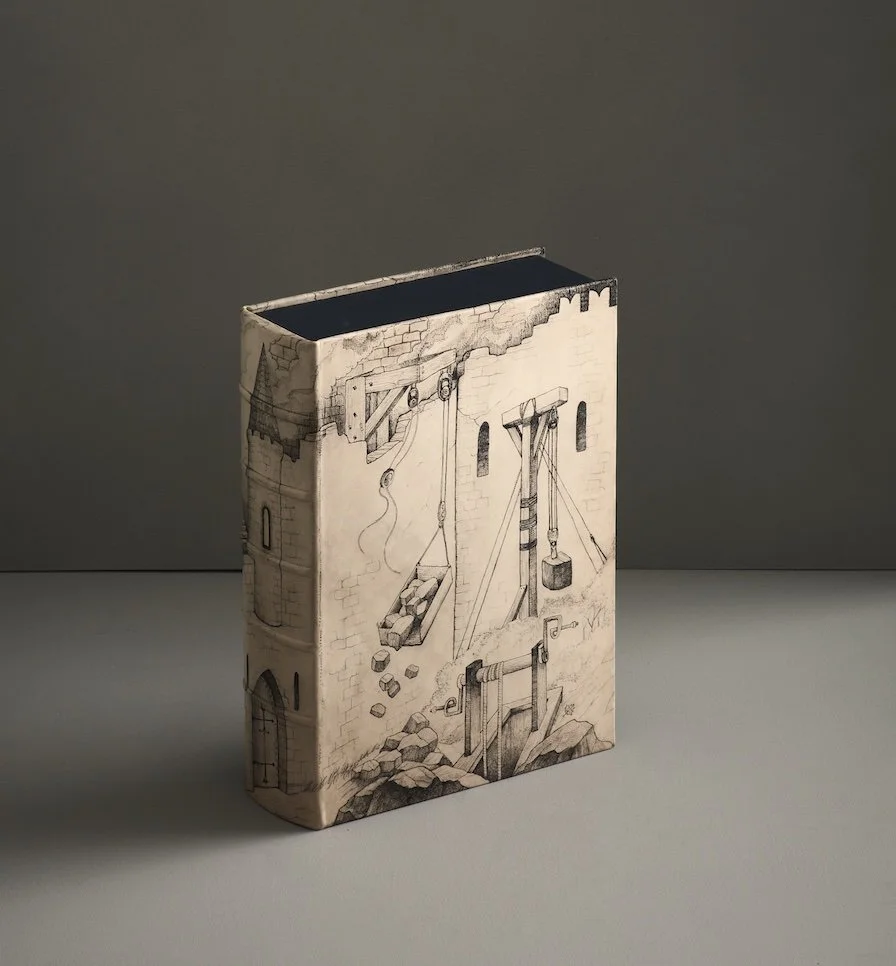
Six clamshells, ( two 27 x 37 x 9 cm, two 17 x 31 x 4 cm and two 10 x 15 x 2 cm). Black ink embedded into fine calf, blue cloth and flocked lining. Three blue, cloth covered intermediate floors. A blue papier mâche hinged box with clasp and silk lining houses the miniature book version of Galileo’s letter to Christina. The four smaller clamshells, intermediate floors and papier mâché box nest within the two larger clamshells. When displayed, the stacked clamshells create a three level 83-cm-high tower.
“ Give me a place to stand and with a lever I will move the whole world”
-Archimedes
Since the origins of human civilization, there has been the intense desire to build bigger, stronger, higher and better. Beginning with crude structures for sheltering our ancestors from the elements, to massive steel structures engineered to reach toward the skies, our passion for creating and building have been matched only by our passion for destruction.
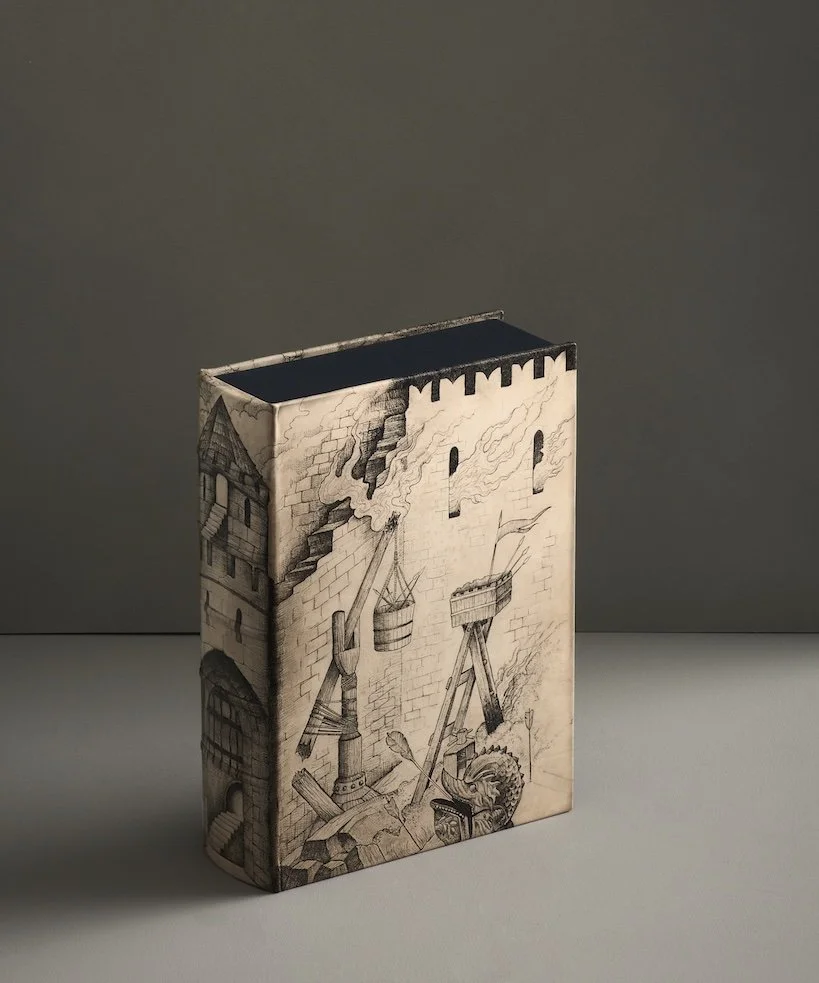
Two unassuming clamshell cases on a shelf, but look closer. The spines depict a story of their own. A stone archway with a portcullis damaged from being forcibly raised, beyond a stairway, a light glows…the ascent continues on the other spine, a lighted window nods to the next set of stairs. Below, a heavy, bolted oak door, strictly monitored by the few who claim total access to the divine. Upward onto the left spine, stone steps lead up to another doorway; a room at the top of the structure…a room of illumination.
Opening the two clamshells reveals a series of smaller clamshells, expertly crafted to fit within. Much like a Russian matryoshka doll, these components are removed one by one to form a three level, three dimensional tower. Once in place, the tower provides an ever-flowing tale of machine engineering for creation and destruction.
Facing the front gate, the left and right panels reach upward on each clamshell depicting machines of war. The military power of the ingenious dragon of Valturius, equipped with a cannon in its terrifying jaws, is wheeled closer to the crumbling walls. Strategic wooden siege mechanisms raise up to access the windows and an attempt to replenish weaponry is hastily repaired. Arrows have rained down upon the battlefield below, the decorated helmet of a nobleman is abandoned after the violence, and fires rage within the mighty stone fortress.
On the second tier, an oversized multi-crossbow machine prepares to shoot its iron payload, while the walls above are structurally compromised by battle damage. On the adjacent panel, a decorative catapult being readied to launch a barrel of explosives, caution now a luxury as the inferno closes in.
The top tier shows fire bursting from the broken windows, toppling stone bricks and an attempted escape plan…homo volans!
Moving around to the rear entrance of the tower, the bolted doorway now being used to guard a sanctuary for the engineers and their craftsmen to use machines to rebuild and restore.
As in any workplace, unforeseen accidents occur…a load of heavy rocks in mid-tumble as ropes snap from the weight. No matter, there are better mechanisms brought in. A robust lift with decorative flair hoists a dense bronze bell with ease, and another solid wooden apparatus brings up a cube of freshly quarried rock.
Above the ground level operation, other machine components are being lifted into place, and stored before their assembly. Ropes and pulleys and wooden beams are carefully set into position, as one error at such heights would prove to be fatal.
The third tier brings the tower back to its former glory, fully repaired with newly installed stained glass. From the illuminated window a renaissance telescope looks to the stars…prompting the audience to look above to the miniature book-well atop the tower, a presentation realm for Galileo.
In the Mark Andrews Collection
Tattooed bindings by A. von Hemmersbach, structural design and layout of tower by A. von Hemmersbach.
Bound, assembled and handcrafted by Keith Felton at Felton Bookbinding Ltd.
Photography by Gary Ogle.